
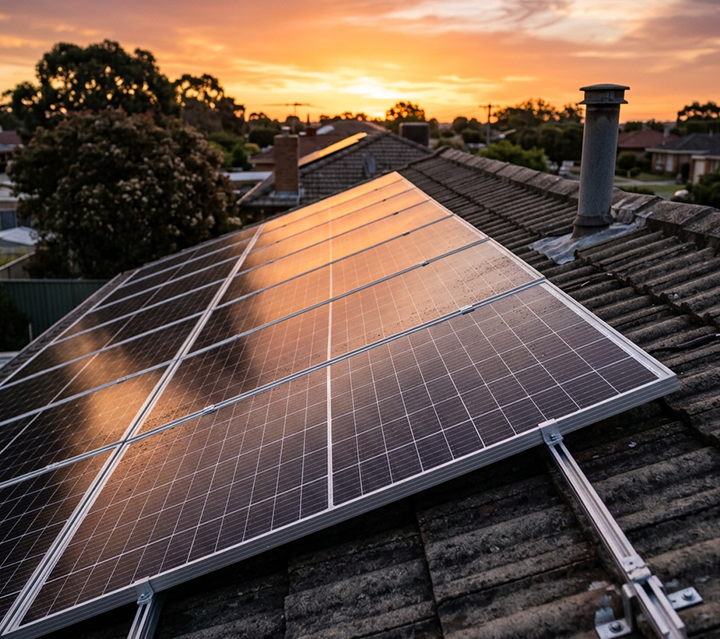
When it comes to electricity there is one thing we can all agree on: we can’t live without it. Sure, some of us enjoy the calm that comes with a power outage, but, for others, this is simply not an option. An extended power outage is often detrimental to our everyday life. Emergency backup isn’t the only benefit of installing solar in your home. Some use solar to make money, while others use solar in order to become less dependant on the grid. Let’s take a look at solar, what it is, what’s the best option for you, and what the financial savings are when you install solar panels.
What is Solar Power and how does it work?
Solar Power is electricity produced from the sun. To my mind that seems weird, but when you look at in in a bit more depth it goes from weird, to fascinating. So, how does sunlight translate to electricity?
To answer that, we need to understand a little bit about light. Within light, are tiny particles known as photons. These photons are little packets of energy that are the smallest particles of light. When light hits a solar cell, these photons essentially collide with electrons inside the solar cell. When photons collide with these electrons, they cause the electrons to start moving. Since Electricity is produced when electrons move, this collision produces electricity. So, in theory, we should be able to hook up a solar panel directly to our home, right? Well, not exactly. The electricity produced by solar panels is DC electricity. In order to power our home, we need AC electricity. But don’t worry, people much smarter than me have come up with a solution.
Invertor
An invertor is a piece of equipment that works to change DC voltage to AC voltage, or vice versa. Without it, there would be no way to use the solar cells, unless we started using DC power in the home. This, however, was ruled out a long time ago because AC is much more efficient than DC when running over long distances (e.g. power lines). Case in point, an invertor allows us to use solar, or battery banks (also DC) as a legitimate source of electricity.
So, what’s the best option for you?
There are many ways to use a solar panel in your home, but we will focus on two.
In this method, electricity from your solar panel feeds your home and any excess goes back to the grid. You will pay the difference between Solar power produced, and Grid power used. Clearly, this provides monthly electricity savings when compared to the average homeowner, who has no solar power.
Instead of excess electricity going back to the grid, any surplus charges the batteries. At nighttime, when there’s no sunlight, these batteries will discharge to power your home. This means, on sunny days, you might not use any hydro at all. In net metering, as soon as the sun goes away, hydro takes over, whereas, in a BES the batteries will take over.
A BES can also be incorporated into a Generac system (Link to Generac) so that if the power does go out, you won’t need to run your generator 24/7.
What are the financial savings when you install solar panels?
For starters, when you install solar panels in Ontario you may be eligible for the Home Renovation Savings Program. With this program, you can receive up to $5000 back for Solar Panels ($1000/kW, up to 50% of total cost), and up to $5000 back for Battery Energy Storage ($300/kWh, up to 50% total cost). Applying for this grant disqualifies you for a Net Metering System.
With Net Metering, you will essentially get a credit for the electricity you produce. This credit is essentially the same amount that you would pay to use electricity from the grid, except that you are now getting paid that amount by way of credit on your next bill. For example, if you each kw/h costs you $0.10 then they will pay you $0.10 for each kw/h you produce.
Conclusion
Whether you’re looking to go green, want to save a bit of money in the long run, or just want a source of backup power, installing solar panels is not a bad way to go. If you have some extra space in your yard or don’t mind putting them on your roof, then they are likely worth a shot. If you are looking into installing solar panels or have any questions about the installation process then feel free to give us a call.